

Update, September 2026: the guarantee is now a Lighthouse SEO score of 100 on every page we build, up from 95.
“SEO” is probably the most expensive word in small business marketing, and one of the least well explained. Owners pay for it monthly for years without ever being shown what was done, and a surprising number of them are paying for advanced work on a site that has not had the basics done at all.
This article is about the basics — specifically, the part of SEO a machine can measure in about ten seconds, which is what Google’s Lighthouse SEO audit does. It is also about a commitment we make on every site we build: any page we deliver that scores under 100 on Lighthouse SEO gets fixed, free, until it is 100. There is no partial credit and no QA floor below it — every check in the category has a known correct answer, so anything short of the full score is simply work we have not finished.
Before that means anything, it is worth being precise about what it is and — more importantly — what it is not.
What SEO actually is
Search engine optimisation is the work of making it easy for a search engine to find your pages, understand what they are about, and decide they are the best answer to somebody’s question. That is genuinely three separate jobs, and they are usually done by three different kinds of effort.
Being findable is technical. Can a crawler reach the page, or is it blocked, broken, duplicated across four URLs, or invisible without JavaScript?
Being understandable is technical and editorial together. Does the page have a title and a description that describe it, one clear heading, and content marked up so a machine can tell a review from a product from an opening-hours table?
Being chosen is everything else — the actual content, whether it answers a real question better than the other results, whether anybody links to it, and how the whole site is regarded over time. This is the slow, human, ongoing part.
Lighthouse SEO covers the first job and part of the second. It cannot touch the third, and anybody who implies otherwise is selling something.
What the Lighthouse SEO audit specifically measures
Lighthouse is an open-source auditing tool built into Chrome — the same one behind the “page experience” numbers you may have seen. Its SEO category runs a fixed set of automated checks and returns a score out of 100. Roughly, it asks:
- Can this page be crawled and indexed? Is it blocked by
robots.txt, is there a straynoindex, do the links have realhrefattributes a crawler can follow, does the page return a successful status code? - Does it describe itself? A non-empty
<title>, a meta description, and alangattribute so a search engine knows what language it is in. - Is the URL situation clean? A valid canonical link, so the same content reachable at several addresses does not compete with itself.
- Is it usable on a phone? A viewport tag, legible font sizes, tap targets that are not on top of each other.
- Is the structured data valid? The machine-readable summary of what a page is (an article, a local business, a set of FAQs) that drives the richer-looking search results.
Notice what is not on that list. Nothing about whether the content is good, or whether the page deserves to rank. It is a checklist of technical hygiene — the automatable floor. Every item on it is a solved problem with a known correct answer, which is exactly why we treat it as a build requirement rather than a service.
Where do you start?
You start here, because this is the part that has a right answer and stays fixed once it is fixed. A missing canonical tag does not need monitoring or strategy or a monthly retainer. It needs to be added once, correctly, by the person building the site.
That is the whole argument for treating it as quality assurance rather than marketing. On every site we build it is a gate the build has to pass before it ships. It is not an upsell and it is not phase two.
So, plainly:
Every page we build scores 100 on Lighthouse SEO. If a page we deliver scores under 100, we fix it free until it is 100.

Our own site, audited on mobile: SEO 100. That is the number the guarantee is about. Performance, Accessibility and Best Practices are shipped at 90+ with the report in front of you — held to the same discipline, but not guaranteed, because they depend on things like the images and fonts a brand arrives with.
Now the important part, and I want to be exact about it, because this is where the industry gets loose.
That guarantee is about the Lighthouse SEO score on a site we build. It is not a promise about rankings, traffic, leads or revenue. Nobody can honestly guarantee those — not us, not anyone, at any price — because they depend on your competitors, your market and a search algorithm none of us control. A 100 does not mean you will rank. It means nothing technical is standing in your way. It is the starting line, not the outcome.
Why this needs saying
Here is what prompted the guarantee.
Over the past while I have sat down with a number of small business owners who were paying for SEO. Not one or two — a pattern. The common figure was around $3,000 a month, on ongoing contracts, some of them running for years. One business had been quoted $10,000 a month by an agency they were seriously considering.
To be fair: none of that is automatically a rip-off. There are agencies doing genuine, difficult, valuable work, and at a certain scale those numbers are entirely reasonable.
But I did what anyone would do and actually looked at the websites. On many of them, barely any of the baseline had been done. Not the sophisticated parts — the Lighthouse parts. Pages without meta descriptions. Missing or contradictory canonicals. Structured data absent or malformed. An afternoon’s work, on sites that had been on a retainer for a year or more.
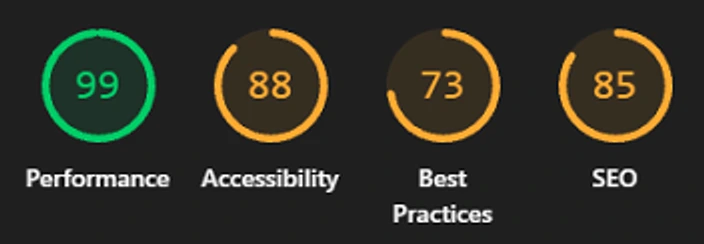
One of the sites I looked at — identity removed. SEO 85. That build would not have shipped from us.
That is what bothers me. Not the price — the idea that you could pay a substantial monthly fee, for months, and still have a site that fails the free automated check anybody can run in Chrome in ten seconds. If the floor has not been swept, it is hard to believe in the ceiling.
You can check this yourself, and you do not need us to do it. Open your site in Chrome, open DevTools, go to the Lighthouse tab, tick SEO, and run it. Whatever the number is, it is a reasonable thing to ask your provider about.
The baseline is not the goal
Everything above is the floor, and I would rather undersell it than oversell it.
Real SEO — the “being chosen” part — is continuous. It is monitoring what people actually search for and what your pages actually rank for, testing changes, measuring whether they worked, and adjusting. It is watching for the things that drift: a page that slows down, a competitor who publishes something better, an algorithm update that changes what gets rewarded. It is not a one-time job, and a good Lighthouse score does not make it one.
What a 100 does is make sure none of that ongoing effort is wasted on a site that cannot be crawled properly. You start from a clean base rather than paying someone to work around a problem that should never have shipped.
That is the honest division: we make the technical baseline right, and keep it right, on what we build. The long game of ranking is real work with no guarantees attached, and we would rather say so than promise you a position on a page we do not control.
If you want to look at it together
You can see how we build in our case studies, and what a build actually involves on the web development page.
If you have an existing site and you would like a straight read on where its technical baseline actually sits — including whether what you are already paying for is covering it — get in touch. We will run the audit and tell you what it says, whether or not the answer leads anywhere for us.