

Every bathroom renovation company I have spoken to loses enquiries in the same place. Someone finds the website, likes the gallery, and asks the only question they actually have: what does a bathroom cost?
The honest answer — “it depends, let’s book a measure” — is true, and it is also where most people leave. Not because they were unserious, but because they have three tabs open and one of the other two will give them a number. The ones who do book a measure are often nowhere near your prices, and either way you have spent an hour in the van finding out.
The problem is not that you refuse to give a price. It is that a real price genuinely depends on the room and the products, and a website has never had a way to ask about either.
Put the asking on the page
That is the idea behind the Instant Quote Designer. Instead of a phone number and a promise, your bathroom page carries a tool that asks the questions you would ask on site, then does the arithmetic in front of the customer.
A visitor sets their room size and where the door is. They pick a floor tile, a wall tile and how high it goes, and a paint colour. They choose a vanity, a toilet, a bath, a shower and a mirror, and slide each one along the wall it belongs on. The whole time they are looking at their bathroom in 3D, from the doorway, updating as they change things.
Then they see an estimate — materials, labour and GST, itemised, calculated from your prices and your labour rates. You decide whether it shows as an exact figure or a range, and you write the disclaimer under it.
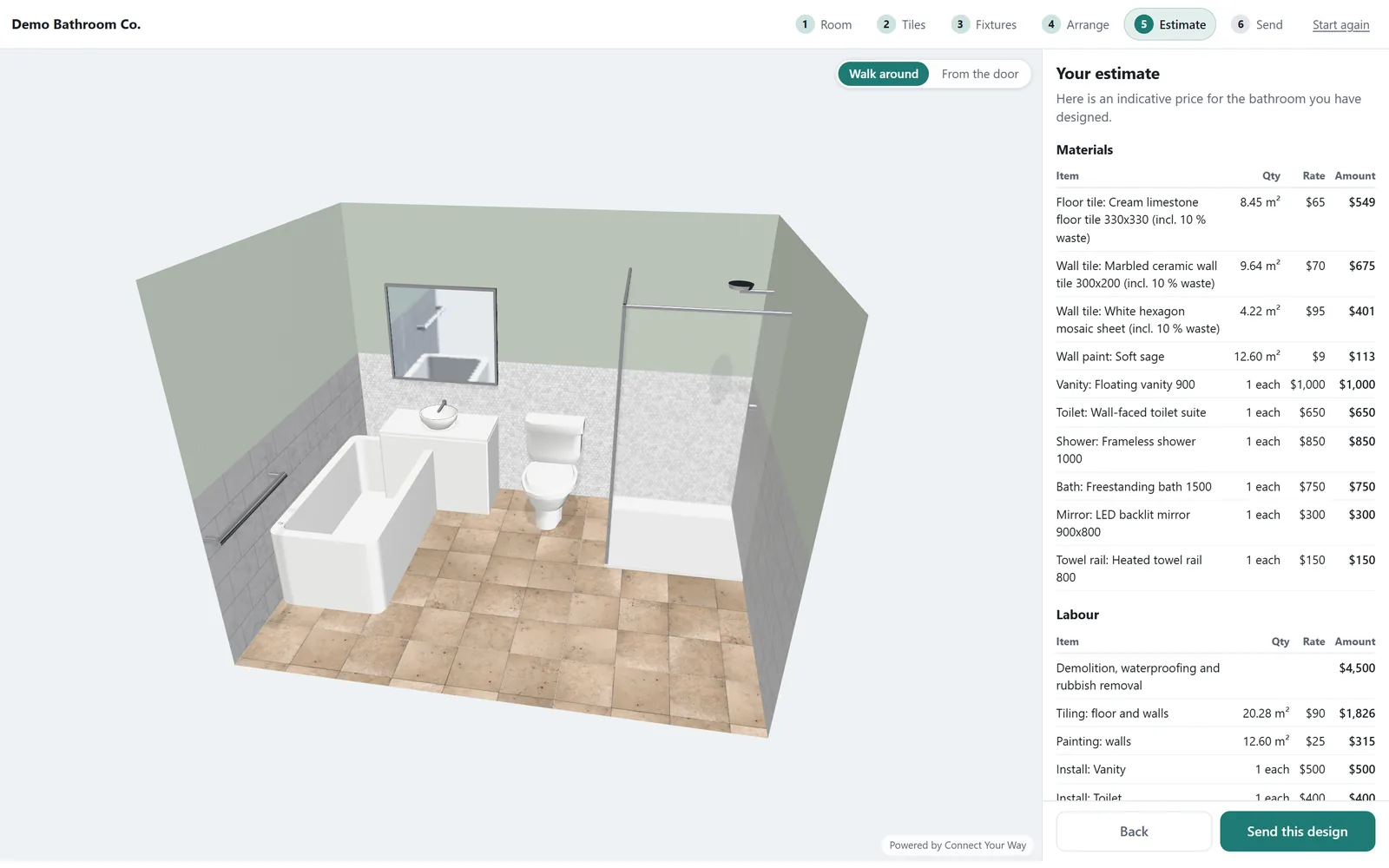
This is the screen your visitor is looking at. Not a form — a room they built, with the arithmetic beside it.
Two things matter more than the number. Everything the customer chose came out of your catalogue: if you don’t stock it, it isn’t on the screen, so the price they see is one you can honour. And it is clearly an estimate, subject to a site inspection — which is what makes the tool safe to run. Nobody is quoting a job sight unseen. You are answering the ballpark question so the people who ring you have already accepted the ballpark.
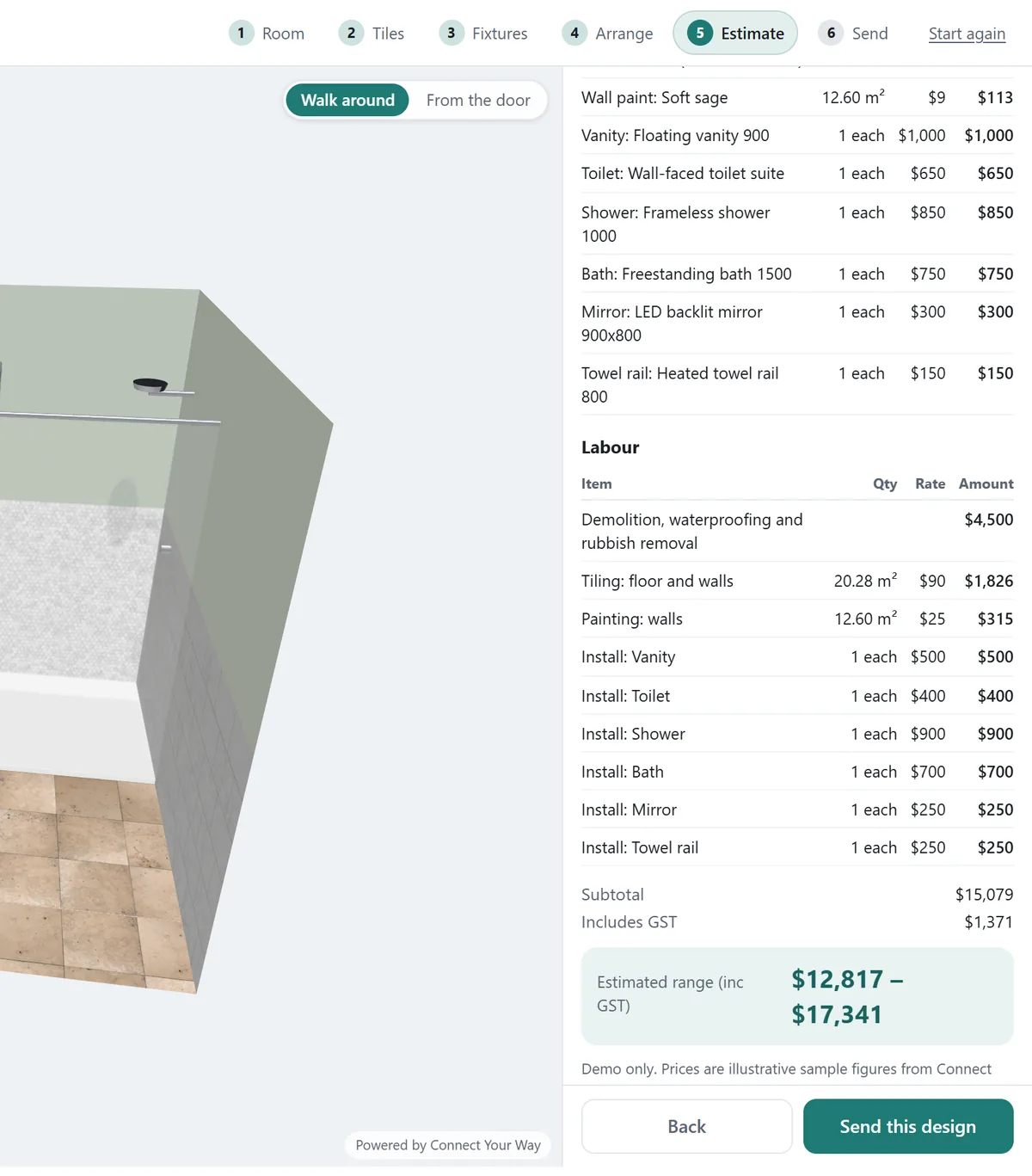
The end of the panel is the whole argument: a subtotal, the GST called out, a range rather than a false-precision number, and a disclaimer the customer reads before they send. Sample prices here — on your site they are yours.
What you get when they press send
This is the part that changes your morning. When a visitor sends their design you get an email with their name, phone and email, the room they drew, every product they chose, the itemised estimate they were shown, and a screenshot of their 3D bathroom.
You are not ringing back to ask what they want. You are ringing back saying “I can see you’ve gone for the 900 vanity and full-height tiling in the shower” — a completely different phone call, and a much shorter one. If you run job-management software, the same lead can be pushed straight into it.
It goes on the website you already have
You do not need a new site. The designer is added to your existing bathroom page with one
<div> and one <script> tag — the same kind of embed code you paste in for a booking
widget or a YouTube video.
It runs inside its own frame, so it cannot inherit your theme’s styling, collide with your plugins, or slow your page down. That isolation is also why it behaves identically on WordPress, Wix, Squarespace or a hand-built site. We host it and keep it updated, and when your supplier prices move you send us the new list.
Most people looking at renovation work are on a phone, so the mobile layout came first: the 3D view across the top, the choices in a sheet underneath, one step at a time.
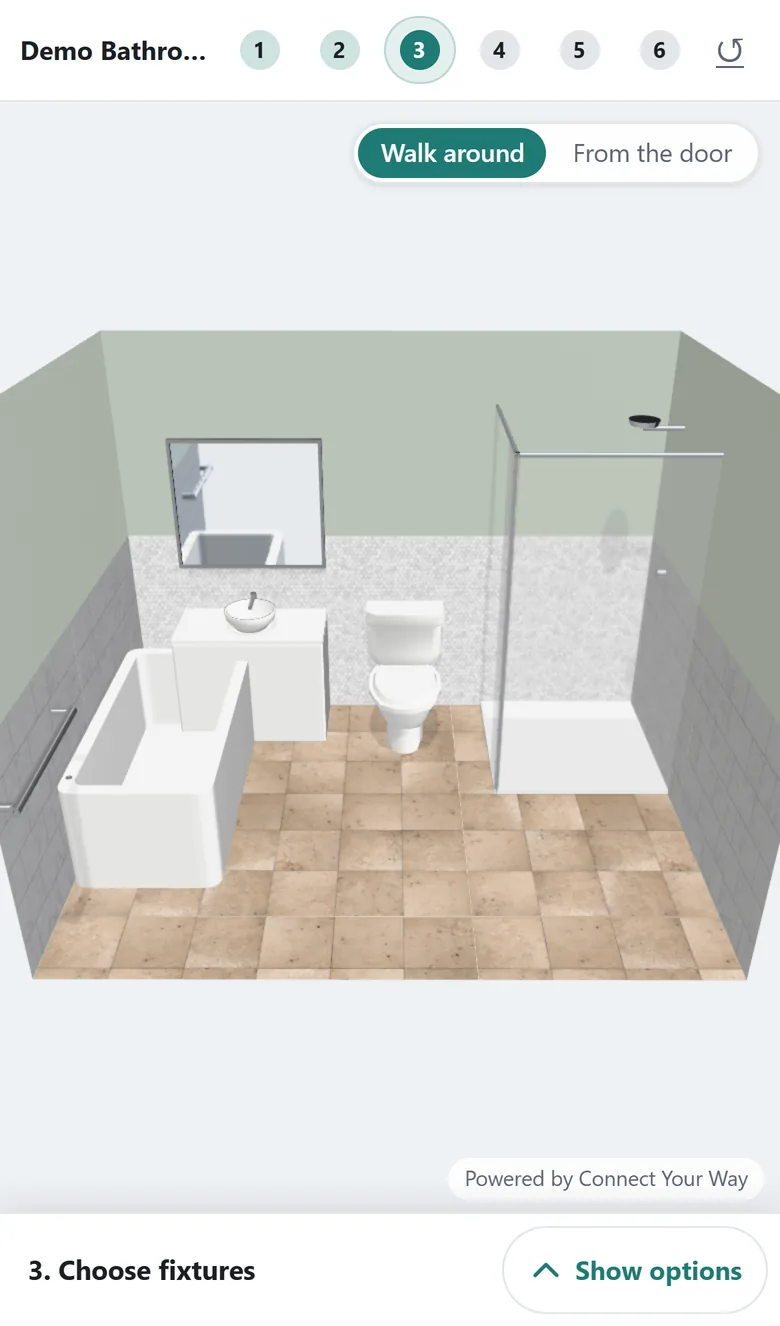
Same step, same room, on a phone: the bathroom gets the screen and the choices come up from the bottom when they are wanted.
What it costs
A tool that talks about pricing should be willing to publish its own, so: $300 a month, plus a one-off setup from $1,600 for the default pack.
The default pack is our standard bathroom catalogue with every component switched on and themed to your branding — around 16 hours of work at $100 an hour, which is exactly where the $1,600 comes from. The monthly fee covers hosting, updates, lead delivery and support, with no cap on how many designs your visitors send. Moving your prices and labour rates during the year is included; send us the updated list and we apply it.
Custom work is quoted after a consultation: your own product catalogue in place of the standard one, components built to your spec, or fitting the designer into an existing site that needs a bit of surgery first. Catalogue additions later on are consulted the same way. I would rather sit down, look at what you actually have, and give you a real number than publish a figure that turns out to be wrong for your job. Either way you know the full cost before you commit to anything.
A detour: we went and looked at the websites
Before building this, we did the unglamorous thing and reviewed bathroom renovation companies’ websites across Canberra and Sydney — dozens of them, one after another, running the same technical checks over each.
The finding was blunt. When we reviewed them, the majority had very poor technical SEO, and many did not clear the Lighthouse SEO baseline at all. Not the competitive part — the baseline: a real page title and meta description, links a crawler can follow, text that isn’t too small to read on a phone, images with alt text, and a page that isn’t quietly telling search engines not to index it.
I am not naming anyone and there is no point being smug about it. Most of these sites were built years ago by someone paid to make them look right, not to make them legible to a crawler, and the companies behind them do genuinely good work. But it does change the advice. If a site cannot clear the baseline, bolting a clever tool onto it is the second thing to fix, not the first — we’ve written separately about where SEO actually starts and why we are willing to guarantee a score.
If the site needs the work anyway, bundle it
So we bundle it. If your website needs the upgrade regardless, we will do the lot as one package: a rebuilt website with the technical SEO baseline sorted, and the Instant Quote Designer built into it from the start. We build to a Lighthouse SEO score of 100, guaranteed — if the site we hand over does not hit it, we keep working until it does, at our cost. That is a guarantee about the score, not a promise about where you rank or how much traffic you get; nobody honest can promise you those. Performance, Accessibility and Best Practices are shipped at 90+ with the report, not guaranteed. And because the designer is being built into a site we are already constructing, its setup fee is absorbed into the build rather than charged on top — you pick up the $300 a month once you are live.
If your site is already in good shape, ignore all of that and take the embed. The two lines work fine on a site we had nothing to do with.
Have a go at it
Talking about a 3D tool is a poor substitute for using one, so there is a live demo on the Instant Quote Designer page, loaded with a sample range. Build a room, tile it, drop in a shower, and ask it for the price. It takes about a minute.
Bathrooms are first because the room is a simple box and the price question comes up on every enquiry. The engine underneath is not bathroom-specific, so kitchens and laundries are the natural next ones. If you would like to see your own range running in it, get in touch and send me your price list.